
This article covers Action Research Projects for 6th and 9th std for the year 2023-24 (Homi Bhabha Exam – Level 3)
Click to jump to 9th Std Project
Topic for 6th Std:
Fashion and Environment
There are two parts in this project. Both are compulsory.
PART 1 – Fashion and Me:
- Analyze fashion-related activities at your home.
- Study: quantity, use, waste, and disposal of items.
- Try to minimize your ‘fashion footprint’
PART 2 – Sustainable Fashion:
- Select any one aspect of fashion.
- Study that aspect. [How it is manufactured, marketed, consumed, and discarded.]
- Suggest an eco-friendly alternative to the same.
- Suggest a creative way of recycling the same
My Example Project for 6th std
Here is my example. Students should try to find their own ideas and are requested NOT to copy this.
Fashionable With Coconut Tree!
– Making fashionable jacket using coconut leaves
My Plan: Making sleeveless fashionable jacket from this material

This jacket is for fashion. Not for utility.
Intended use is not rain protection or cold protection.
Intention is fashion.
Scientific Approach:
Design aspects, manufacturing aspects, cost, time, materials used
Action Plan:
- Learn making cloths, shapes, cuts required for sleeve-less jackets
- Taking my own measurements, drawing
- Actually making the jacket.
- Using the Jacket and getting feedback
Add-Ons:
- Ideas to put ecofriendly buttons, or use of coir or wool
- Add pocket to the jacket, add a hook to put on a hook after use.
- Putting suitable reusable edge protector.
Other ideas:
– Can it be painted?
– Can it be wax coated?
– Can any other things be used to decorate it?
Using the Jacket
- Wear it for birth day party. And family function. Wear it at public places.
- Check durability of jacket
- Check water resistance
- Check if there is change in color texture.
Feedback: Check and collect genuine feedback from people
- Study others reactions without telling them about your project
- Tell a few people that you purchased it from your friend. Its cost was Rs 200. see their reaction.
- If any of your friend wants it, talk to their parents if they want to purchase, immediately make one more, nicely pack and sell.
- If you are able to sell, that means product is really useful.
- If not, report honestly.
Other Ideas
- Make Fashionable Hats of same material
- Make badges of same material used at events/ functions
- Make scented oil using prajakta flower juice. Or other flower juice
- Making shell earrings
- Make necklace from small colourful stones.
- Design fashionable ladies purses out of natural materials like jute
- Make bracelets from long dried leaves of coconut tree
Example given by Homi Bhabha people
Manuskichi Bhint – For Sharing and reuse of personal fashion items.
Topic for 9th Std:
Bioindicators
This year’s topic is somewhat difficult. Let us try to understand what it means.
A Bioindicator is a species or community or biological process that indicates quality or condition of the ecosystem.
Some Examples (Source: Wikipedia)
1. The “disappearance of lichens” in a forest is a bioindicator that may indicate environmental stresses, such as “high levels of SO2”
2. “Population of certain species of American crows” is a bioindicator that may indicate the “presence of West Nile virus disease”
3. “Population of frogs near a water body” may indicate the contamination level or presence of toxins.
Active and Passive Bioindicators
Active: the bioindicator is purposely put into the test environment
Passive: The indicator is naturally present.
What students should do
- Select any bioindicator, Study it. Study the parameter it indicates.
- Establish correlation between the selected indicator and the said environmental parameter.
- Find and implement remedial measures to minimize negative impact of human activities on the environmental factors.
- Bring awareness to improve the environmental health
- Document traditional knowledge
- Participate in science projects related to bioindicators.
Some examples of bioindicators and the parameter they indicate:
| Bioindicator | Parameter it indicates |
| Diet | Health blood pressure, cholesterol, energy level, digestion, any other health aspect |
| Weight loss or BMI reduction | Malnutrition. |
| Lichen | Air quality |
| pH of road side leaf extract | Road pollution |
| Bioindicator | Parameter it indicates |
| Nutrients in soil Soil pH Earthworm density in soil | Quality of soil Soil pollution |
| Study of wheeds and plants like Amaranthus and Polygonum | overgrazing |
| Flowering / fruiting of trees ecosystem of tree | Air, soil, light, water pollution |
| Bioindicator | Parameter it indicates |
| Presence of pests | Cleanliness/ soil pollution |
| concentration of students | noise pollution |
| Flowering / fruiting of trees ecosystem of tree | Air, soil, light, water pollution |
| Some parameter of birds or humans | Pollution due to electromagnetic waves |
| impact on birds | deforestation |
| marine biodiversity mangroves | Impact of various human activities / water pollution |
| Bioindicator | Parameter it indicates |
| biodiversity in the water | Water pollution |
| Eichhornia abundance | sewage and heavy metal pollution in water |
| groundwater indicators trees like Banyan tree, cluster fig, tamarind | Quality, availability, depth of ground water |
| Quantity of wind or solar power installations | ?? |
| Abnormalities in bees | Presence of pollution or pesticides |
| local biodiversity | climate change |
MY EXAMPLE
Dirty pigs and the alarms they raise!
Study of the bioindicator ‘Population of pigs’ to indicate ‘Soil pollution and cleanliness’
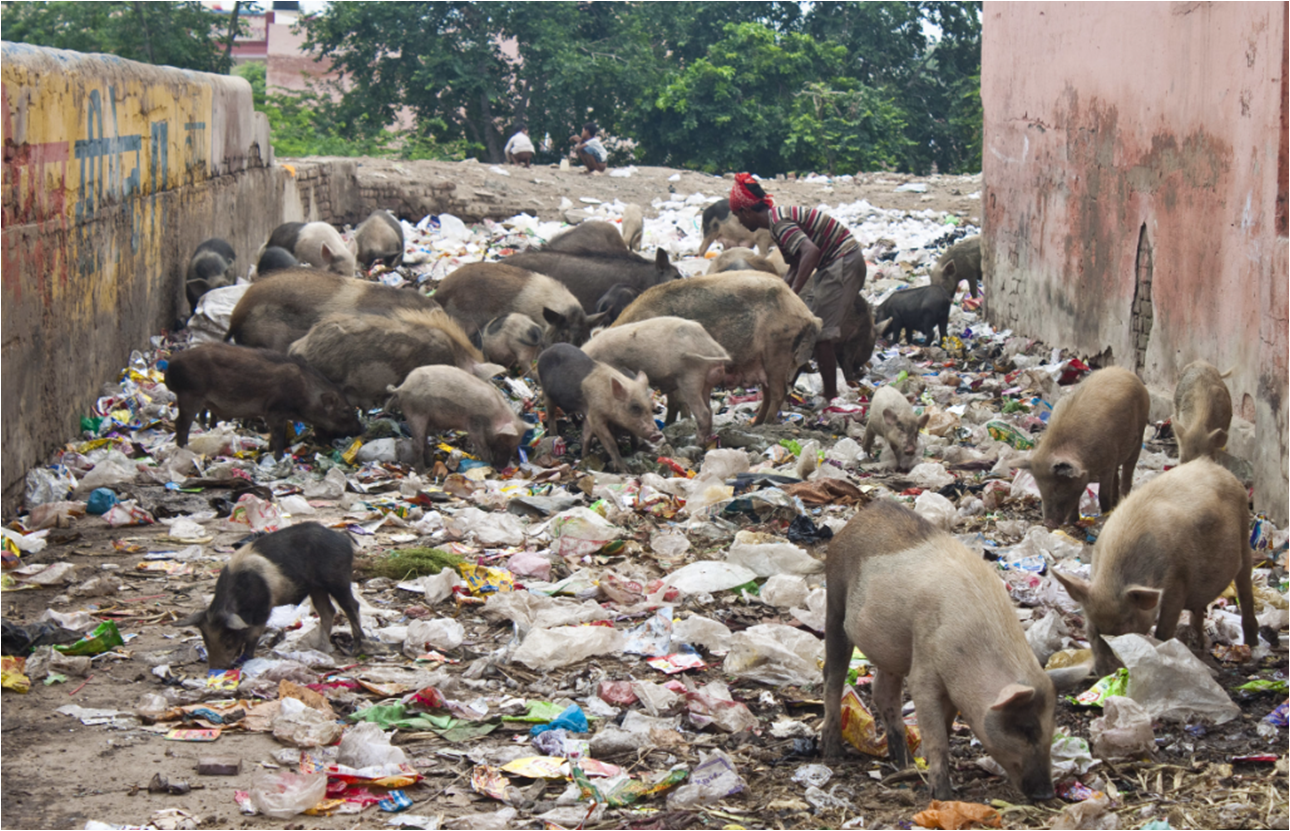
Large number of pigs = Dirty city!
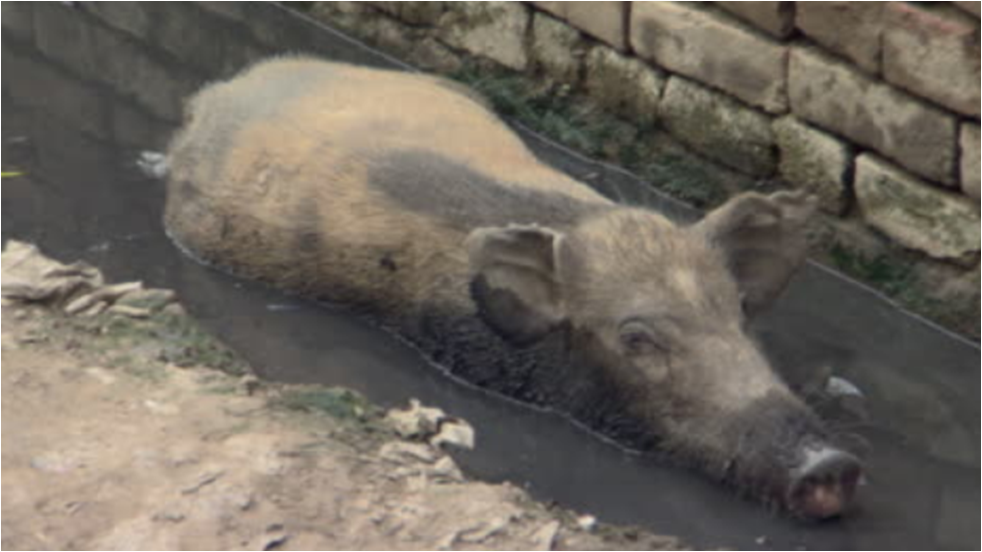
Selecting the study locations
- I will select total 5 to 7 locations around the city.
– Extreme garbage and pollution
– Medium
– Relatively less garbage areas - I will consider other parameters such as:
– Amount of Human presence nearby
– Other animals
– Availability of water, sunlight etc - Study and measurement of garbage:
I will the study and measure the following parameters of garbage:
– Quality [dry, wet, metal, biodegradable, non biodegradable, cooked food, farm waste, animal waste, human excreta, etc]
– Quantity of garbage [area, volume]
– Presence of water [quality and quantity of water]
– Quality of air [partials, smell etc]
– Environmental parameters at the site [temperature, sunlight]
– Presence of humans [Human activities at / around site]–Presence of other animals/ plants at site - Study and measurement of pigs
– Quality of pigs [activeness]
– Health of pigs
– Dirtiness of pig - Study of Pig population
– Size of pigs
– Activities of pigs
– Males / females/ baby pigs
– Pig enemies [if any predators or humans eat them] - Establish the correlation
– I will try to find the correlation between the two parameters based on the study done at 5 locations.
– I will try to find if there is any possibility of secondary correlations. Like: quantity of water / number of mosquitos, smell present in air/ sunlight etc with the bioindicator [number of pigs]. - Remedial measures and implementation
• Try to get one [small] location clean.
• Put bleaching powder, or other pesticides.
• Observe disappointment of pigs when they come here and find a clean area.
• See if pigs avoid that area. - Documentation
• Try to find if there is any traditional knowledge about this bio indicator.
• Document if found.
Spreading awareness
I will do the following to create awareness about pigs as a bioindicator –
• Show beautiful photos and videos of pigs in garbage to my friends. Spread awareness among them about this newly found bioindicator.
• Explain to them that pigs too are part of food chain and as per environment activities, may be we need to conserve the pigs.
• Run a debate at school – “Should we clean all the garbage and let the pigs die out of hunger”
OR “Should we become humanitarian by continuously maintaining the garbage to feed the pigs?”
This example is just a guideline. We will suggest that you do not copy it directly. Come up with your own idea. Only then you will feel like working on it wholeheartedly.
All the best!
Rahul and Udita Ogale (9892013836)
 Ogale Learning Centre